About this time, everybody loathed Rubik for his devilish invention. There had been more screams of frustration than there were laughs at any of Dane Cook's shows. Then came the hero, a 12-year-old schoolboy from England. WFT?! Patrick Bossert published the book You Can Do The Cube. It continued on to sell over 1.5 million copies. So now, people that had the patience to read through the book, and play with the cube enough, could solve it. They became gods. Even though the information was highly accessible, those who could solve the cube were seen as amazing geniuses. Yes, it does take a certain amount of brain capacity in order to memorize the algorithms and when one uses said algorithms, but anyone could solve one it they really wanted to.
Ernő wanted so present a new challenge to his loyal consumers, and that's what he did. He patented the Pocket Cube in 1983, a less intimidating version of the Rubik's Cube. The pocket cube consists of a 2x2x2 as apposed to a 3x3x3 design. It is constructed entirely of corner pieces. It didn't take long for most cubers to realize that one would the solve the Pocket Cube by simply using algorithms from the 3x3x3 to solve only the corner pieces. Many people think that this is an easier Rubik puzzle to solve. While, it probably is the easiest of Rubik's cubes, it still requires a relatively high amount of brain power to memorize all the needed movements.
The Rubik's Cube (3x3x3) and the Pocket Cube (2x2x2) are probably the most know of all the cubes. But they don't stop there. Though the Rubik's revenge was named after Ernő Rubik, it was actually designed by Péter Sebestény. It was released around the same time the Pocket Cube was, but had a much different effect on the public. People went insane. There were riots in the streets of Hungary, in which many people were killed. There were multiple assassination attempts to rid the world of Ernő Rubik. Yes, I just made all of that up. No, none of that happened. But it still causes many brains to puke, and even a few people to cry in frustration.
Yet once again, Ernő didn't stop there. Then came the release of the Rubik's Professor. Invented by Udo Krell, the 5x5x5 cube consists of 150 stickers and 99 pieces. I don't think I really need to say much more.
Another company, V-Cube, has become the biggest company for 5x5x5s and up. They manufacture the V2 (2x2x2) though the V11 (11x11x11). I love these guys. You can check out their site if you don't believe me.
Though the Rubik's company is most famous for their cubes, they also have been the masterminds behind things such as the Rubik's World, Rubik's UFO, Rubik's Revolution, Rubik's Magic, Rubik's 360, Rubik's Homer Simpson, Rubik's Mirrors, Rubik's Icon Cube, Rubik's Twist, Rubik's Clocks, Rubik's Shells, Rubik's Bricks, Rubik's Touch, Rubik's Slide, Rubik's Tangrams, Rubik's Sudoku, and the Rubik's Tic Tac Toe. Following, is a list of pictures of all of those, so you can get a feel for how creative those at the Rubik's company are.

The Rubik's World, a 2x2x2 Ball.
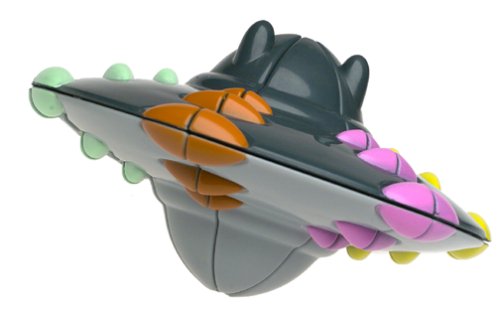
Rubik's UFO, you just have to see it.
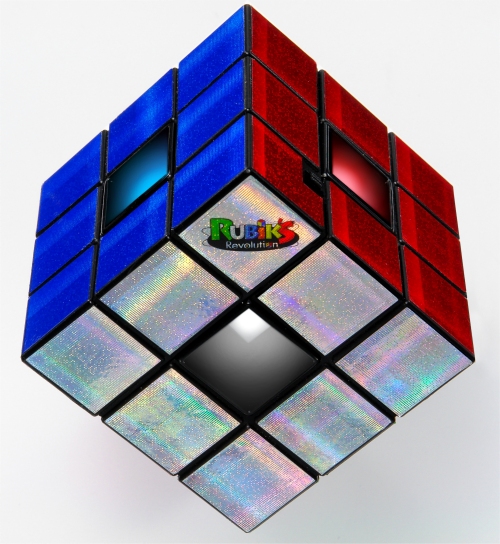
The Rubik's Revolution retained the original cube shape, but does not turn at all. The goal is to find the lit center piece, and push it as fast as you can.
I hate it.
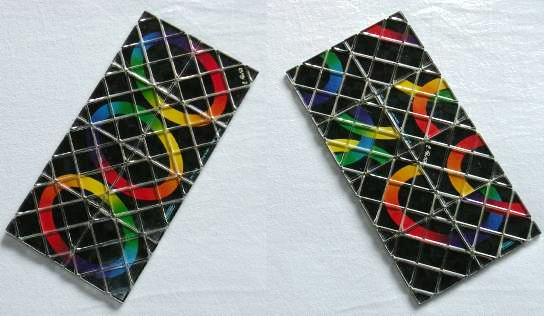
The Rubik's Magic is another one you should see as apposed to read about.

The Rubik's 360 consists of three spheres all inside one another, and small balls. The goal is to get all of the small balls into their bubbles on the outer most sphere.

The Homer Simpson Cube
One of America's favorite cartoon character's bust as a 2x2x2, what could be better?

Rubik's Mirrors is a Rubik's cube with one color: a mirror. But, the trick is that each of the cubies are different shapes. That's just cool.

A Rubik's Cube with various shades of black and white, and one side made of mirrors, as seen on the Mirror's Cube (above), the Icon Cube can be a little more challenging, but the tactic for solving are the same.

Unlike anything else, the Rubik's Twist can be formed into almost any shape you want. Here's a video of it.
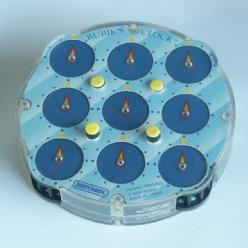
The goal of the Rubik's Clock is to get all nine of the analog clocks to read 12 o'clock. This thing is crazy.
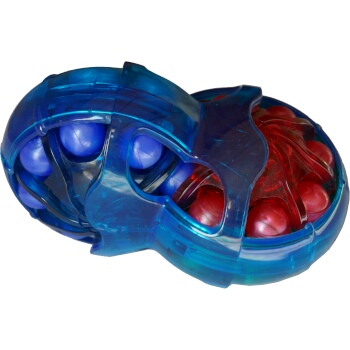
Rubik's Shells, who knew? Check it out here.

When the Rubik's Bricks fall apart, you have to arrange them to achieve the classic cube once again.

The Rubik's Touch is the latest puzzle from Rubik. At a pricey $149.99 this cube cannot be twisted, but with the swipe of a finger along a row, the cube responds by rotating the lights accordingly. Since only the rows on the up side of the cube can be moved (to prevent accidental moves), this puzzle bends the minds of even the most experienced cubers.

Another new puzzle, the Rubik's Slide calls for the player to copy the movement that lights up on the screen by twisting an sliding the top of the puzzle in a plethora of movements.

Very similar to the Rubik's Brick (above), the goal of Rubik's Tangrams is to complete the square by nesting all of the polygons together.

This is what you get when you combine the two most popular puzzle games in the world; The Rubik's Sudoku.

And this is what you get when you combine the best selling toy in the world with the childhood game everybody knows; Rubik's Tic Tac Toe
So, as you can see, the Rubik's cube is much more than just a confuzzling cube that everybody hates to love. It has become a cultural symbols of sorts. It was estimated that about one-fifth of the world population had played the cube, in the 1980s. Can you imagine how many people have played with a cube by now? I know I can't. I lost my hearing aid, so I'm having trouble seeing today...
Email me at monkeyt211@gmail.com if you have any questions about where to find more information on the cube and/or other Rubik's products. I can also tell you where to find all of the puzzles above, and most all others, so ask me for a price check instead of trying to search the junk pile that is the internet for help on where to buy them. Good luck fellow cubers!


